COURSES
Clear, easy and well understandable video Lectures, making learning effortless for thousands of students.
.jpg)
Logic and Critical Thinking
Logic and Critical Thinking is one of the most intellectually stimulating yet challenging courses for freshman students. This module consists of six comprehensive chapters, starting with the foundations of philosophy, its meaning, branches, and importance. Students then explore the basics of logic, including the nature and structure of arguments, how to identify and evaluate them, and the different types of reasoning. The course also examines the close relationship between logic and language, touching on the cognitive and emotive meanings of words, definitions, and philosophical interpretation of terms. Further chapters introduce the core principles of critical thinking, the common Fallacies (errors in reasoning) found in arguments, and finally, an in depth look at categorical propositions and their logical structure. While the course builds essential thinking skills, many students find it difficult due to its abstract nature often resulting in low grades and disappointing department placements. At Havan Academy we turn this challenge into an opportunity. Our approach makes Logic Simple through engaging, easy, and well understandable video lectures, exam focused summary notes, and hundreds of university specific practice questions for each chapter. If you’re aiming to Achieve high GPA and secure your dream department, we’re here to guide you every step of the way. Your GPA matters! This is Havan Academy, Pioneer Institution in providing Freshman Course Tutorial since 2012 e,c and Became Trusted and Top Ranked Online Learning Center. we brought schools into your hand. Your GPA Matters !
Psychology
General Psychology is the scientific study of human behavior and mental processes. This course introduces students to the fascinating world of how the mind works and how people think, feel, and act. The first chapter presents psychology as a discipline, highlighting its purpose and importance. Chapter two explores how we experience the world through sensation and perception, the foundation of all mental activity. In chapter three, students dive into learning understanding how we acquire new knowledge and behaviors. This includes the principles of learning, influential factors, and major theories such as behavioral, social, and cognitive learning theories. Chapter four focuses on **memory its processes, stages, why we forget, and how to improve memory. Chapter five covers motivation and emotion, examining what drives human behavior, types and theories of motivation, emotional components, and their practical applications. The sixth chapter explains personality theories, including psychoanalytic, trait based, and humanistic approaches. Chapter seven discusses psychological disorders, their causes, types, and available treatment methods. The final four chapters (eight to eleven) focus on life skills such as self-awareness, emotional intelligence, stress management, decision-making, academic strategies, communication, teamwork, and handling social pressures. Despite its importance, many students find Psychology difficult due to its broad and abstract content often leading to low grades and unsatisfying department assignments. At Havan Academy, we make Psychology easy and enjoyable to learn. Through clear, easy and well understandable video Lectures, exam oriented summary notes, and hundreds of university specific practice questions, we help you master the course and excel in your exams. If you're aiming to raise your GPA and secure your Dream department, Havan Academy is here to help you s쳮d. Your GPA truly matters!
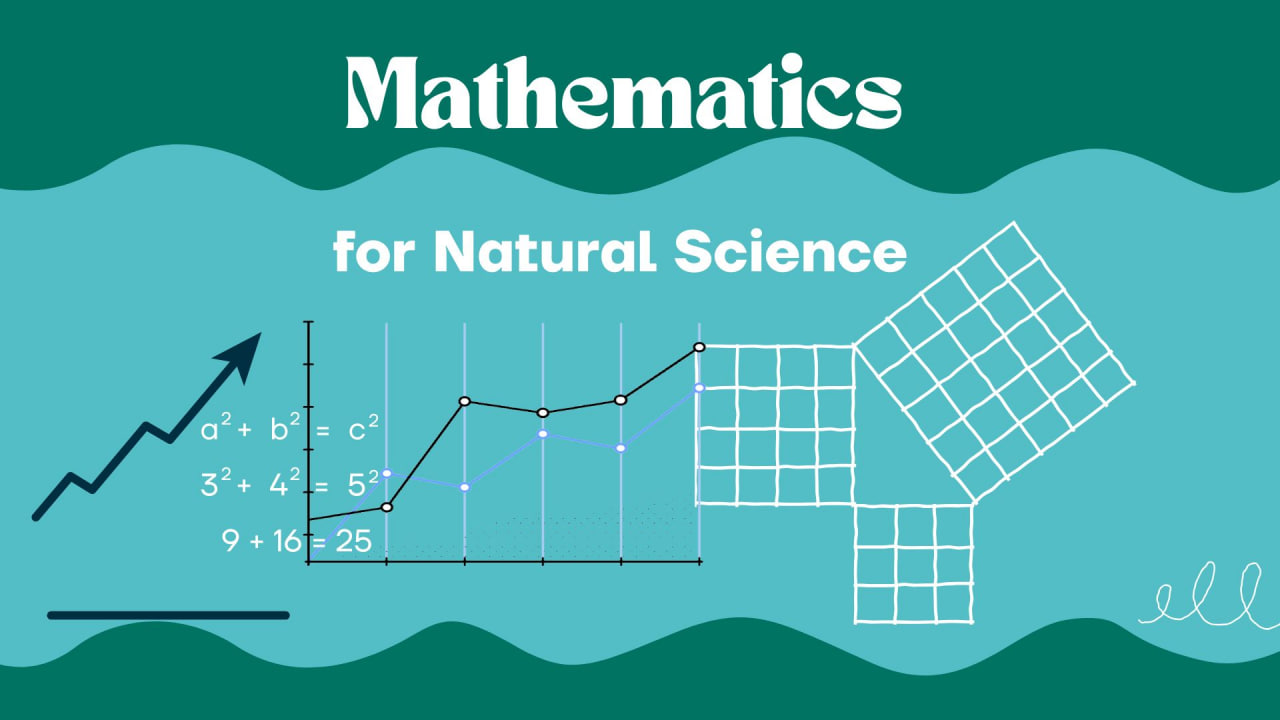
Maths for Natural Science
Mathematics for Natural Sciences is a core freshman course that introduces students to essential mathematical concepts and techniques used in higher education. The course covers essential mathematical topics including propositional logic and set theory, real and complex number systems, functions and their properties, as well as analytic geometry involving lines, circles, conic sections, and more. These topics are not only theoretical but also play a major role in solving real world scientific problems. Despite its importance, this course is often seen as one of the most difficult subjects for first year students, frequently leading to low grades and missed opportunities for top department placements. At Havan Academy, we make this subject easy to understand with clear and simplified video lectures, exam Oriented summary notes, and hundreds of your university specific Previous year exam questions. Our goal is to help you boost your GPA and secure your dream department. Your GPA truly matters!

Maths for Social Science
Mathematics for Social Sciences is a core freshman course designed to build essential quantitative and logical reasoning skills for social science students going to economics, management, law, and other social science Departments. The course is structured into four major chapters. Chapter 1 introduces students to propositional logic and set theory, including logical connectives, arguments and validity, quantifiers, and basic set operations laying the foundation for analytical thinking. Chapter 2 focuses on functions, where students explore the real number system, solve linear and quadratic equations, and understand key types of functions such as polynomial, exponential, logarithmic, and trigonometric functions and their graphs. Chapter 3 delves into matrices and determinants, covering matrix operations, row echelon forms, solving linear systems, and applications like Cramer’s rule. Chapter 4 presents an introduction to calculus, including limits, derivatives, integrals, and their applications in solving real-world problems. Many students find this course difficult due to its abstract concepts and fast pace often leading to low GPAs and undesired department placements. At Havan Academy, we make this subject easy and enjoyable through easy, clear and well understandable video Lectures, exam oriented summary notes, and hundreds of university specific practice questions. If you're aiming to achieve high GPA and secure your dream department, Havan Academy is here to guide you. Your GPA Matters!
.jpg)
Physics
General Physics for Natural Sciences is a comprehensive freshman course designed to give students a strong foundation in the principles of physics and their applications across scientific fields. The course is divided into seven major chapters except for AAU, at AAU ot has 13 chapters. Chapter 1: Preliminaries introduces physical quantities, measurements, units, vectors, and significant digits. Chapter 2: Kinematics and Dynamics covers motion in one and two dimensions, Newton’s laws, forces, energy, momentum, and planetary motion. Chapter 3: Fluid Mechanics explores properties of matter, pressure, buoyancy, and Bernoulli’s equation. Chapter 4: Thermodynamics discusses temperature, heat, thermal expansion, heat transfer, and the first law of thermodynamics. Chapter 5: Oscillations, Waves, and Optics delves into simple harmonic motion, pendulums, wave properties, resonance, the Doppler effect, and image formation. Chapter 6: Electromagnetism and Electronics focuses on electric fields, current, resistance, circuits, magnetic fields, induction, and basic electronics like diodes and transistors. Finally, Chapter 7: Cross-Cutting Applications highlights the role of physics in agriculture, health, industry, archaeology, and space sciences. While this course is foundational and highly relevant, many students find it challenging due to its analytical nature and wide scope. At Havan Academy, we simplify the learning process through clear and well understandable video Lectures, exam oriented summary notes, and hundreds of university specific practice questions. Our goal is to help students fully understand each concept, perform confidently in exams, and secure high grades that lead to their desired department placements. Your GPA matters!
.jpg)
English Skill 1
Communicative English Skills (English 101) is a foundational university course (for freshman student) designed to strengthen students’ academic language proficiency and overall communication abilities in English. The course emphasizes the real-world application of English in both academic and everyday settings, focusing on four core skills: reading, writing, speaking, and listening. Students are guided through structured lessons that teach them how to express ideas clearly, write well organized essays, participate in academic discussions, and deliver confident presentations skills that are critical for success in any field of study. At Havan Academy, we make mastering English 101 simple and effective. Our expert instructors deliver clear, easy, and well understandable video lectures thoroughly prepared for deep understanding. We provide exam oriented summary notes, hundreds of practice questions (University specific), and interactive learning materials to ensure you're fully prepared for university assessments. At Havan Academy our motto is "Your GPA matters!" so if you want to score high in your freshman exams, Havan Academy gives you the tools, guidance, and confidence to s쳮d. Join us today and start learning smarter. Your GPA Matters!
.jpg)
Geography
Geography of Ethiopia and the Horn (GeES 1011) is a required course for first year students in Ethiopian higher education. . The course is designed to familiarize students with basic geographic concepts specific to Ethiopia and the Horn of Africa, fostering geographic literacy and a sense of place and time needed to understand and resolve spatial problems. It highlights the implications of Ethiopia's location, shape, size, and its diverse physical and human resources on socio-economic development. The initial part introduces Geography's definition, scope, approaches, and five basic themes, Basic map reading skills, including principles and types, are also discussed. The second major part focuses on the physical background and natural resource endowment of Ethiopia and the Horn. Topics include Geology, exploring Earth's evolution, processes, the formation of the Rift Valley, and Ethiopian mineral resources and potential sites. Topography, Drainage Systems and Water Resources, The Climate, Lastly, Soils, Natural Vegetation, and Wildlife Resources are addressed. The third and fourth components cover the demographic characteristics and economic activities. At Havan Academy, we simplify the learning process through clear, easy and well understandable video Lectures, exam focused summary notes, and hundreds of your university-specific practice questions. If you want to achieve high GPA and secure your dream department, Havan Academy is the right place. Your GPA matters!
.jpg)
Python
This course introduces students to the world of programming using Python one of the most powerful, beginner friendly, and in demand programming languages today. Python will give you the digital edge to solve problems, automate tasks, and build real-world applications. Students will explore:/n The basics: variables, data types, and control structures/n Functions, loops, and error handling/n Working with files and real-world data/n Intro to Object-Oriented Programming (OOP)/n Simple projects like calculators, data analysis, or games/n
.jpg)
Emerging Technology
This first year course introduces students to the exciting world of emerging technologies that are transforming the global landscape including Ethiopia. From artificial intelligence to biotechnology, from blockchain to the Internet of Things (IoT), students gain a broad understanding of how innovation is driving change across industries, societies, and economies. Designed for all fields of study, this course helps students:/n Understand key 21st-century technologies/n Explore how these innovations impact health, education, agriculture, business, and governance Analyze the ethical, social, and economic implications of new tech/n Discover local and global opportunities in tech-driven development/n

Economics
This foundational course introduces first-year university students to the essential principles of economics, with a focus on both microeconomics and macroeconomics. Designed to reflect the Ethiopian economic context and global economic systems, it equips students with the tools to understand how individuals, businesses, and governments make decisions in the face of scarcity. Through real-world examples, interactive lessons, and simplified economic models, students will explore core topics such as: Supply and demand dynamics Market structures and pricing National income and inflation Fiscal and monetary policies Economic development in Ethiopia Global trade and investment Your GPA Matters !

Global Trend
Global Trends (Global Affairs) is a common course for first-year university students in Ethiopia, designed to introduce learners to the key political, economic, and social dynamics shaping the modern world. The course provides a foundational understanding of international relations and Ethiopia’s place within the global system. It is structured into five comprehensive chapters, each addressing a critical area of global affairs. The first chapter focuses on the fundamentals of International Relations, exploring concepts like nationalism, statehood, the evolution of the international system, and the roles of both state and non-state actors. It also introduces major theories such as realism, liberalism, and constructivism. The second chapter delves into Foreign Policy and Diplomacy, covering the concept of national interest, tools of foreign policy, and a historical overview of Ethiopia’s foreign policy from the imperial era to the present day. The third chapter introduces International Political Economy (IPE), where students learn about global trade, finance, investment, and the influence of major international economic institutions such as the WTO, IMF, and World Bank. The fourth chapter examines Globalization and Regionalism, addressing the debates around globalization, its impact on Africa and Ethiopia, and the rise of regional integration efforts. It compares different models and theories of regionalism. The fifth chapter explores Major Contemporary Global Issues, including global security, environmental concerns, socio-economic challenges, and cultural transformations. Students are encouraged to critically analyze how these issues affect both global stability and Ethiopia’s development

Anthropology
Dive into the science of humanity a journey through time, culture, and identity. Our freshman Anthropology course explores seven engaging chapters, from human evolution and cultural diversity to language, archaeology, and contemporary global issues. Your GPA Matters !
